APPLICATIONS
Where Coconut Shell Activated Carbon Makes the Difference
Coconut shell activated carbon is the preferred choice for the world’s most demanding industrial applications — from drinking water purification to pharmaceutical-grade processing. Its superior hardness, high iodine value, and consistent pore structure make it the benchmark against which all other activated carbons are measured.
Water Treatment
The largest application for coconut shell activated carbon globally. Used in municipal drinking water systems, industrial process water, and point-of-use filtration to remove chemical contaminants, taste, and odor.
What It Removes
- Chlorine and chloramines (taste & odor)
- Trihalomethanes (THMs) and disinfection byproducts
- Pesticides, herbicides, and organic micropollutants
- Pharmaceutical residues and endocrine disruptors
- Volatile organic compounds (VOCs)
- Color and turbidity in surface water
Typical treatment process
01
Pre-chlorination
The largest application for coconut shell activated carbon globally. Used in municipal drinking water systems, industrial process water, and point-of-use filtration to remove chemical contaminants, taste, and odor.
02
GAC filter bed
Granular activated carbon packed into pressure or gravity filter vessels. Water passes through at controlled flow rate.
03
Monitoring & regeneration
Iodine value decline monitored. Carbon replaced or regenerated when adsorption capacity is exhausted.
Recommended PRODUCTS
Coconut Shell GAC — Standard & NSF Grade
Iodine Value
950 - 1100 mg/g
Mesh size
6x12 8x30 12x30 12x40 20x40 30x60
Moisture
< 5%
Ash content
< 5%
Certification
NSF/ANSI 61
MOQ
20 MT (1 FCL)
Gold Mining — CIP & CIL Process
Activated carbon is the backbone of modern gold recovery. In Carbon-in-Pulp (CIP) and Carbon-in-Leach (CIL) processes, coconut shell activated carbon adsorbs dissolved gold from cyanide leach solutions — making it one of the most technically demanding applications for activated carbon globally.
Why coconut shell is the gold standard
Coconut shell activated carbon outperforms coal-based carbon in gold recovery for two key reasons: superior hardness (abrasion resistance) — critical because carbon circulates continuously through the slurry and must not break down into fines that are lost — and high surface area with optimal pore structure for gold-cyanide complex adsorption.
- Gold-cyanide complex [Au(CN)₂⁻] adsorption
- Silver and platinum group metal recovery
- Carbon must withstand elution at 110–120°C
- Regenerated carbon reused 5–10 cycles
Recommended PRODUCTS
Coconut Shell GAC — Gold Mining Grade
Iodine Value
≥1,000 mg/g
Mesh size
6x12 8x16
Moisture
< 5%
Ash content
< 3%
Ballpan Hardness
> 95%
MOQ
20 MT ( 1 FCL )
Food & Beverage
Activated carbon is widely used in food processing for decolorization, deodorization, and purification of liquids. Applications range from sugar refining and edible oil processing to beverage clarification and citric acid purification. Food-grade certification is mandatory.
Key applications in food processing
- Sugar refining — removes color bodies and impurities from cane and beet sugar syrup
- Edible oil — decolorization and deodorization of palm, coconut, and soybean oil
- Beverages — wine, beer, and spirits — removes off-flavors, color, and oxidation compounds
- Sweeteners — glucose syrup, fructose, and high-intensity sweetener purification
- Organic acids — citric acid, lactic acid color and odor removal
- Amino acids & vitamins — decolorization in fermentation processing
Recommended PRODUCTS
Coconut Shell GAC / PAC — Food Grade
Methylene Blue
≥150 mg/g
Iodine Value
1000 - 1100
Ash Content
< 5%
Iron content
≤500 ppm
Activation method
Steam only (no chemicals)
Certification
Halal MUI · JECFA
MOQ
5 MT (powder) · 20 MT (granular)
Pharmaceutical
Pharmaceutical-grade activated carbon demands the highest purity standards of any application. Used for API purification, process water treatment, and removal of trace impurities in drug manufacturing. Acid-washed grades with ultra-low iron content are required.
Critical requirements
In pharmaceutical manufacturing, contamination is not acceptable at any level. Activated carbon must be acid-washed to remove soluble ash components and reduce metal content — particularly iron — to below 100 ppm. IP (Indian Pharmacopoeia) and USP (United States Pharmacopeia) standards govern carbon quality for pharmaceutical use.
- API (Active Pharmaceutical Ingredient) purification
- Removal of genotoxic impurities and reaction byproducts
- Process water and WFI (Water for Injection) treatment
- Fermentation broth decolorization
- Solvent recovery and purification
Recommended PRODUCTS
Acid-Washed Activated Carbon — Pharma Grade
Iron Content
<100 ppm
Ash content
≤3% (ultra-low)
Iodine Value
≥900 mg/g
Methylene Blue
≥150 mg/g
pH
6.0–8.0 (neutral)
Compliance
IP / USP compatible
MOQ
5 MT
Air Purification & Industrial Gas Treatment
Activated carbon is highly effective for removing gaseous contaminants from air and industrial gas streams. Applications include VOC removal, solvent recovery, odor control in industrial facilities, and mercury capture from flue gas.
Key contaminants removed
- Volatile Organic Compounds (VOCs) — benzene, toluene, xylene
- Hydrogen sulfide (H₂S) and mercaptans — odor control
- Industrial solvents — acetone, ethanol, ethyl acetate
- Ammonia and amine compounds
- Mercury vapor in industrial flue gas
- Chlorine and acid gases in industrial exhaust
Industries served
Recommended PRODUCTS
Coconut Shell GAC — Vapor Phase Grade
CTC (CCl₄) Activity
≥60%
Mesh size
4×8 · 6×12
Iodine Value
1,000–1,200 mg/g
Moisture
≤5%
Hardness
≥97%
MOQ
20 MT (1 FCL)
Industrial Wastewater Treatment
Industrial effluent often contains organic pollutants, heavy metals, and trace chemicals at concentrations that conventional biological treatment cannot handle alone. Activated carbon provides the polishing step that brings wastewater to regulatory discharge standards.
What it treats
- COD and BOD — chemical and biological oxygen demand
- Phenols and chlorinated organics from chemical plants
- Dyes and color compounds from textile manufacturing
- Pharmaceutical compounds in hospital effluent
- Cyanide residuals from electroplating and mining
- PFAS and persistent organic pollutants
Recommended PRODUCTS
Coconut Shell GAC — Industrial Grade
Methylene Blue
≥120 mg/g
Mesh size
8×16 · 12×40
Iodine Value
800–1,000 mg/g
Ash content
≤8%
Hardness
≥95%
MOQ
20 MT (1 FCL)
Quick References
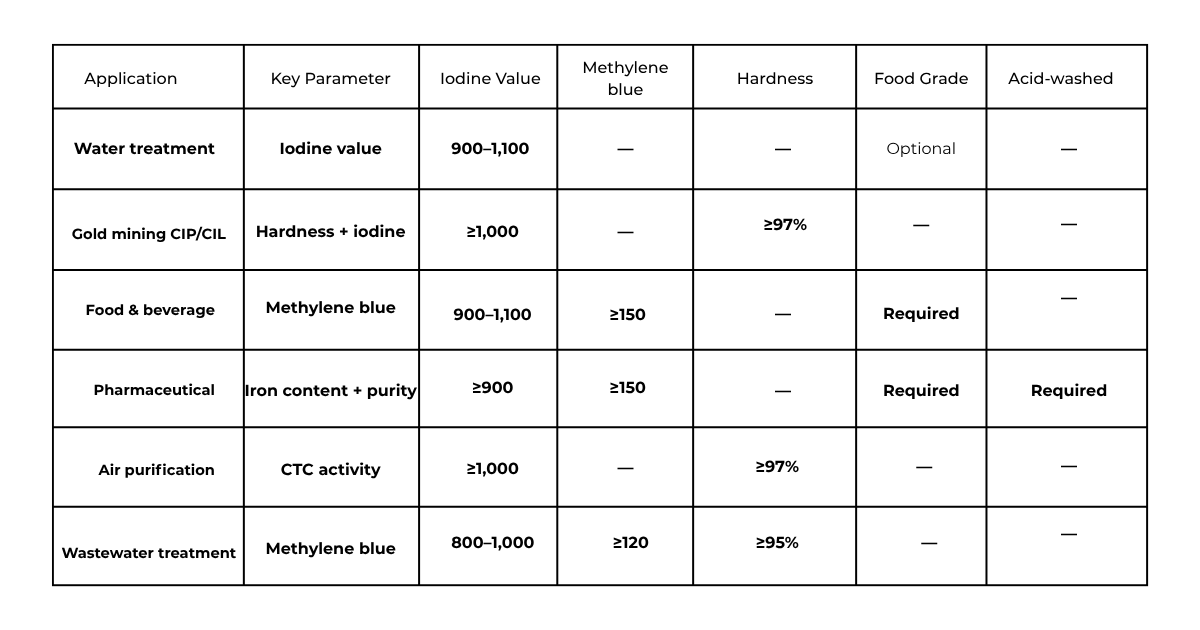
Application vs. key parameter guide
Use this table to identify which product parameter matters most for your application.
Technical FAQ
Common questions from procurement engineers
Answers based on the most frequent questions we receive from international buyers.
Why is coconut shell preferred over coal-based activated carbon?
Coconut shell carbon has a predominantly microporous structure, making it ideal for small molecule adsorption (water treatment, gold). It is also significantly harder and more abrasion-resistant, which is critical in applications where the carbon is mechanically agitated. Coal-based carbon has a broader pore distribution more suited to larger molecules.
What is the difference between iodine value and methylene blue value?
Iodine value (mg/g) measures microporosity — adsorption of small molecules, primarily used for water treatment and gas-phase applications. Methylene blue value measures mesoporosity — adsorption of larger molecules, important for color removal in food and beverage applications. The best carbon for decolorization is high in both.
Can the same carbon be used for both water treatment and food processing?
Technically yes, but regulatory requirements differ. Water treatment carbon requires NSF/ANSI 61 certification. Food processing carbon requires food-grade certification (JECFA, Halal). We recommend specifying your application upfront so we can provide the correct grade with the right documentation.
What does "steam-activated" mean and why does it matter?
Steam activation uses high-temperature water vapor (800–1,000°C) to create the pore structure. No chemical activating agents (ZnCl₂, H₃PO₄) are used. This is important for food-grade and pharmaceutical applications where chemical residues are unacceptable. It also produces a cleaner carbon with lower ash content.
How do I select the right mesh size for my application?
Mesh size affects contact time and pressure drop in your system. Larger mesh (4×8, 6×12) = lower pressure drop, shorter contact time. Finer mesh (12×40) = more surface area per volume, higher pressure drop. Most water treatment systems use 8×30 or 12×40. Mining typically uses 6×12. We can advise based on your system design.
Do you provide samples before bulk order?
Yes. We provide samples (typically 1–2 kg) to qualified buyers before bulk order commitment. Sample delivery takes 5–10 business days. Please specify your target specification and application so we send the correct grade. Sample cost is offset against your first commercial order.
Get a Quote
Ready to source? Let's talk specifications.
Fill in your requirements and we’ll respond within 24 business hours with a formal quotation and product data sheets tailored to your application.
- Response within 24 hours
- Free sample available for qualified buyers
- COA and spec sheet included with quotation
- Buyer information kept confidential
- Prefer WhatsApp? Chat directly with our export team